
Industry Portal
Related News
- 00
0000-00
Sustainable Travel Material Standards: Which Certifications Should Buyers Check? - 00
0000-00
Which Silicone Luggage Accessories Help Protect Your Suitcase During Air Travel? - 00
0000-00
Global Travel Accessory Market: Demand Shifts, Channel Growth, and Risks for Brands - 00
0000-00
Choosing Coated High-Performance Fabrics for Weather-Resistant Outdoor Applications - 00
0000-00
What Travel Goods Buyers Should Check When Evaluating Private-Label Suppliers
Tags
ECHA PFAS Rule Tightens EU Rainwear Exports
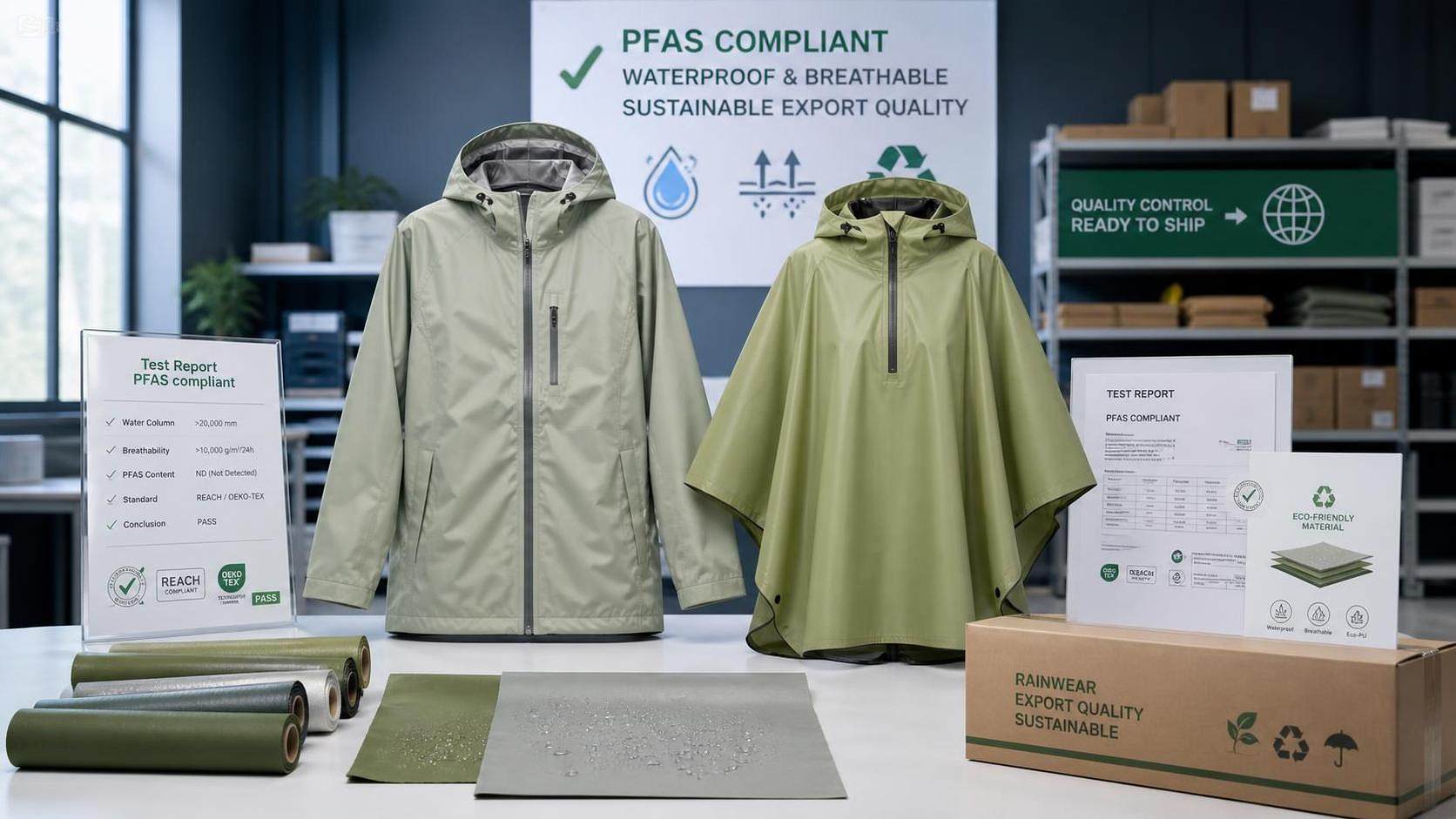
On August 10, 2026, the European Chemicals Agency (ECHA) put PFAS restriction provisions under REACH into force for PFAS-containing textile coating products, bringing rainwear categories such as TPU Breathable Raincoats and Eco-PU Fashion Ponchos into direct compliance focus. For exporters shipping rain gear to the EU, the immediate issue is no longer only product formulation, but also whether testing documents and supply chain declarations can be prepared in time before the new documentation requirement starts on November 1, 2026.
What the New Requirement Covers
According to the provided information, ECHA announced on August 10, 2026 that PFAS restriction provisions formally took effect under REACH. The scope covers all textile coating products containing PFAS, including products described as TPU Breathable Raincoats and Eco-PU Fashion Ponchos.
The same information states that from November 1, 2026, rainwear products exported to the EU must be accompanied by a PFAS-Free test report issued by an ISO 17065-certified body, along with a supply chain declaration. The restriction is described as having a direct effect on the compliance path and customs clearance timing of Chinese rainwear exporters.
Where the Pressure Will Be Felt First
Exporters facing a tighter documentation threshold
From an industry perspective, direct trading companies are likely to feel the impact first because the rule affects the documents that must accompany EU-bound rainwear shipments. The main pressure point is execution: whether export files can match the new requirement in a complete and timely way, especially when shipment schedules depend on customs clearance speed.
Manufacturers tied to coated rainwear categories
Processing and manufacturing businesses producing coated rainwear may be affected because the rule specifically reaches textile coating products containing PFAS. For these companies, the issue is not only product production itself, but also whether product-related testing and upstream declarations can support export delivery requirements for TPU- and PU-based rainwear categories mentioned in the provided summary.
Procurement and supply chain coordination becoming more visible
Raw material sourcing teams and supply chain service providers may also be affected because the new requirement combines a PFAS-Free test report with a supply chain declaration. Analysis shows that this creates a coordination task across suppliers, factories, traders, testing bodies, and shipment preparation teams. Any mismatch between product files and supporting declarations could affect delivery timing.
What Companies Should Watch Closely Now
The gap between rule effective date and filing deadline
What deserves closer attention is the distinction between the August 10, 2026 effective date and the November 1, 2026 document submission requirement for EU exports. In practical terms, companies involved in rainwear exports need to track whether internal compliance preparation can be completed within that window.
Whether target products fall into the affected coating scope
Businesses should review whether their export items fall within the coated textile product scope described in the provided information, especially rainwear products comparable to TPU Breathable Raincoats and Eco-PU Fashion Ponchos. This is a product-line question first, and a sales question second, because scope identification determines which orders may need immediate document preparation.
Readiness of testing and declaration materials
Observably, the operational challenge is not limited to obtaining a PFAS-Free test report. The requirement also includes a supply chain declaration, which means document readiness depends on cooperation across multiple parties. Companies should therefore pay close attention to whether supplier qualifications, product files, and declaration language can support export fulfillment without delay.
Customer communication and delivery scheduling
For teams serving EU buyers, another practical focus is order communication. Where exports are time-sensitive, customers may begin asking earlier about PFAS-Free status, supporting reports, and declaration availability. The issue here is less about marketing claims and more about whether shipment timing and compliance documentation remain aligned.
Why This Reads as More Than a Routine Update
Analysis shows that this development is best understood as a concrete compliance change rather than a distant policy signal. The reason is straightforward: the provided information includes both a formal effective date and a clear future requirement for documentation tied to exports.
At the same time, it is more appropriate to understand this as an evolving compliance matter rather than a fully settled end state for the market. The confirmed facts establish the requirement and its direct relevance to rainwear exports, but day-to-day implementation will still depend on how companies organize testing, declarations, and shipment preparation in practice.
How the Sector May Need to Read This Moment
For the rainwear export business, the immediate significance of this update lies in compliance execution. It points to a shift from general awareness of PFAS-related restrictions to document-backed export readiness for affected EU-bound products. For companies tied to TPU- and PU-coated rainwear, the practical question is whether internal and supplier-side compliance materials can support uninterrupted delivery after November 1, 2026.
Taking only the confirmed information into account, this is more appropriately understood as a near-term operational compliance requirement with longer-term significance for product and supply chain management. It is not simply a headline policy development, but neither should broader market conclusions be overstated beyond the facts currently provided.
Basis of This Article and What Still Needs Verification
This article is based on the user-provided news title, event date, and event summary. The confirmed inputs used here are the August 10, 2026 timing, ECHA's announcement that PFAS restriction provisions under REACH formally took effect, the coverage of PFAS-containing textile coating products including TPU Breathable Raincoats and Eco-PU Fashion Ponchos, and the requirement from November 1, 2026 for PFAS-Free test reports issued by an ISO 17065-certified body together with supply chain declarations for rainwear exported to the EU.
For this type of industry update, source categories typically relevant to later verification include official notices, company disclosures, industry association information, authoritative media coverage, and standard-related documentation. A specific official source link was not provided in the input, so the exact official reference still requires ongoing verification. Follow-up attention should focus on any later official wording, implementation clarifications, and documentation expectations affecting export practice.