
Industry Portal
Related News
- 00
0000-00
How Weatherproof Apparel Technology Companies Validate Waterproof Breathability - 00
0000-00
Carry-On Travel Luggage: How to Choose a Cabin Bag That Fits Airline Limits - 00
0000-00
Umbrella Product Testing: Which Wind, Rain, and UV Tests Matter Most? - 00
0000-00
How to Choose Wheeled Luggage for Smooth Airport Transfers and Long Trips - 00
0000-00
Outdoor Shade System Pricing: What Drives Installed Cost for Commercial Projects?
How Weatherproof Apparel Technology Companies Validate Waterproof Breathability
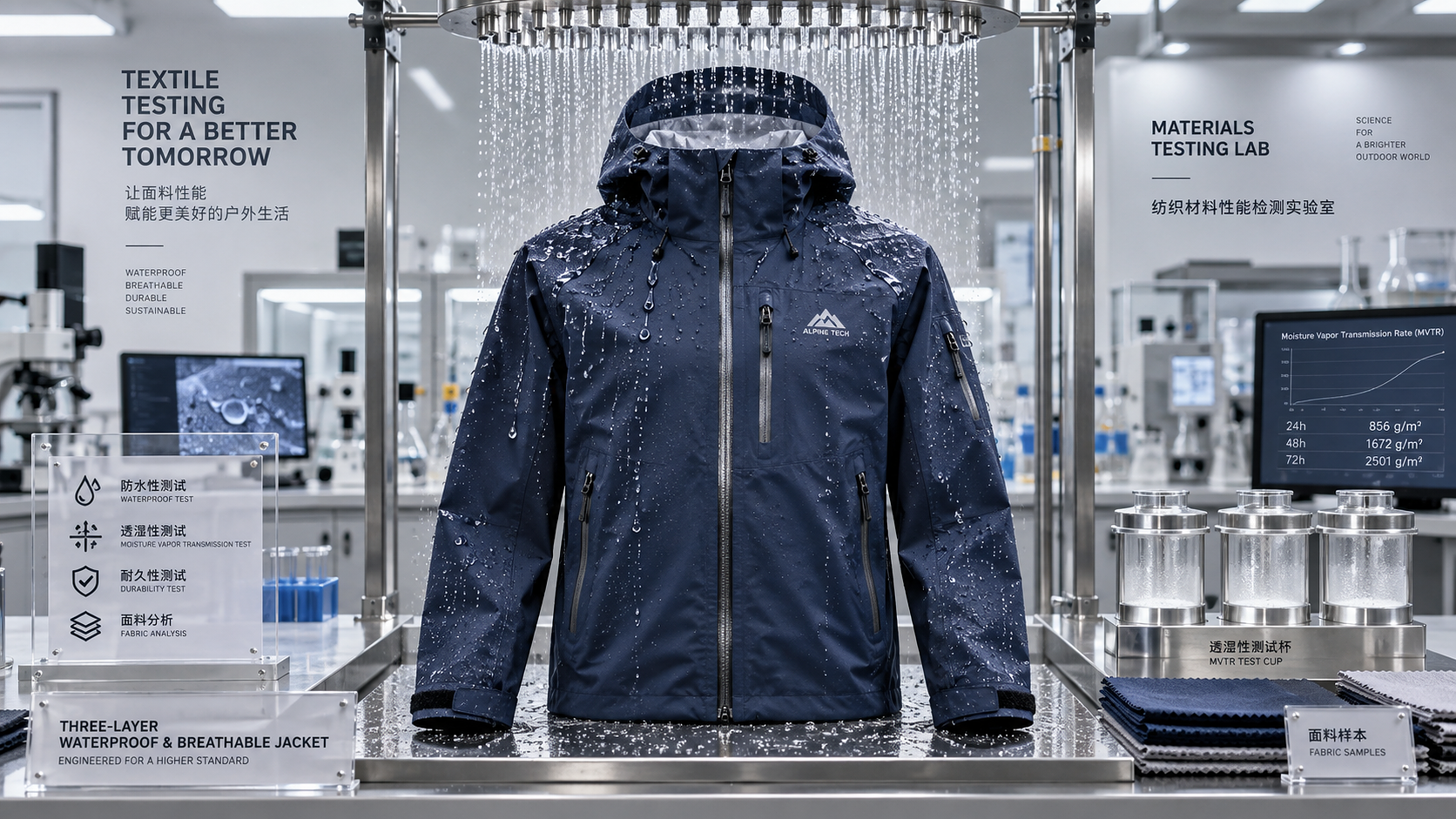
How Weatherproof Apparel Technology Companies Validate Waterproof Breathability
A waterproof jacket can look convincing on a showroom rack and still fail during a wet commute, a long hike, or a day of repeated pack-on and pack-off use. For technical evaluators, that is the central problem: waterproof breathability is not one material claim. It is a system-level performance outcome shaped by face fabric, durable water repellent treatment, membrane or coating, lamination quality, seam tape, garment construction, and the way the finished product is maintained.
A capable weatherproof apparel technology company does not validate this system with a single hydrostatic-head figure. It builds an evidence trail. That trail usually includes laboratory testing of water resistance and moisture transport, inspection of seams and construction details, durability testing after washing or abrasion, and wear trials that expose the garment to movement, humidity, pressure, and real rain. The important question is not simply whether a fabric passed a test once. It is whether the performance remains credible after the garment has been cut, sewn, packed, washed, and worn as intended.
Waterproofness Begins with the Right Test, Not the Highest Claim
Hydrostatic head is the most familiar waterproofness metric. In broad terms, it measures how much water pressure a textile can resist before leakage occurs. ISO 811 and AATCC 127 are commonly referenced methods for determining resistance to water penetration under hydrostatic pressure. They are useful because they allow material developers, garment brands, and sourcing teams to compare constructions under controlled conditions.
But hydrostatic head should never be read in isolation. A membrane laminate may show a strong laboratory result while the finished jacket leaks at a shoulder seam, zipper edge, hood adjustment point, or pocket opening. Pressure also changes in actual use. A backpack strap, kneeling position, bicycle saddle, or folded garment trapped under a bag can create localized force that a simple rain exposure does not reproduce well.
This is why technical review should separate at least three questions: the waterproofness of the base fabric, the integrity of the laminated composite, and the water resistance of the finished garment. A supplier report that identifies only the fabric result is incomplete for a rainwear program. It may be sufficient for an intermediate material review, but it does not close the risk around construction.
Surface wetting is another source of confusion. A jacket can remain technically waterproof while its outer fabric becomes saturated, often described as “wetting out.” Water may not penetrate the membrane, yet the wearer feels cold, clammy, and less comfortable because moisture transport is impeded and the face fabric no longer sheds water efficiently. Spray testing, including methods such as AATCC 22 or ISO 4920, is therefore relevant when evaluating the condition of the water-repellent surface. It is not interchangeable with hydrostatic-head testing.
Breathability Is a Measurement Problem as Much as a Material Problem
“Breathable” is often used too broadly in product briefs. In technical terms, the property normally concerns the movement of water vapor through a material. Moisture vapor transmission rate, commonly shortened to MVTR, is one way to express that movement. Methods such as ASTM E96 and JIS L 1099 are widely used in the industry, but results from different procedures should not be treated as directly equivalent.
That distinction matters in supplier comparison. Test temperature, relative humidity, air movement, specimen orientation, and whether the method is upright cup, inverted cup, or another approach can all influence reported values. A technical evaluator should request the method, conditioning details, laboratory identity, test date, sample description, and whether the reported number is an average of multiple specimens. Without that context, an impressive MVTR figure can be more promotional than useful.
Even a carefully measured fabric result does not fully predict comfort. Breathability in a jacket is affected by the air gap between garment and body, garment fit, activity level, lining construction, vent placement, and the outer fabric’s wet condition. A commuter shell worn over office clothing behaves differently from a close-fitting trail shell used during sustained uphill movement. In humid rain, the vapor-pressure difference between inside and outside may be small; no membrane can ignore the physics of the environment.
For that reason, experienced developers usually treat MVTR as a screening and benchmarking tool, not as a promise of universal comfort. A more credible validation package links material data to the intended activity: city cycling, travel use, workwear exposure, trail walking, fishing, or emergency rain protection. The required balance changes with the use case.
Membranes, Coatings, and Laminates Need Different Review Logic
Weatherproof apparel can use microporous membranes, hydrophilic membranes, polyurethane-based coatings, TPU laminations, or layered hybrid constructions. None is automatically the best choice. The appropriate technology depends on target performance, fabric weight, stretch requirement, hand feel, expected washing frequency, cost structure, repairability, and the environmental chemistry permitted by the market.
A two-layer, 2.5-layer, or three-layer construction also changes the review. Three-layer systems can offer robust internal protection and a cleaner interior finish, while lighter constructions may be better suited to packable emergency shells. Neither format should be selected solely because it sounds more technical. The garment category matters. A lightweight travel raincoat, for example, has different priorities from industrial rainwear or a shell intended for repeated abrasion under a backpack.
Seams and Components Often Decide Whether the Garment Works
Needle holes are deliberate openings in an otherwise waterproof barrier. Seam tape exists to seal those openings, but tape quality alone is not enough. Evaluators should examine tape width, overlap, adhesive compatibility with the laminate, tape application temperature, seam geometry, and the fabric’s ability to tolerate the process. Curved hood seams, gussets, articulated elbows, and tightly radiused pocket corners deserve extra attention because they can be harder to tape consistently.
Component choices need the same scrutiny. Water-resistant zippers, storm flaps, zipper garages, cuff closures, drawcord exits, logo applications, and welded pocket assemblies all create potential ingress paths. A garment may pass a fabric-level hydrostatic test and still show practical leakage when water is driven against a front zipper or collects at a hood-to-collar junction. Inspection should include both dry visual checks and wet testing of finished samples.
This is particularly relevant for rainwear suppliers serving commuters and travel brands. A person wearing a backpack places persistent pressure on shoulder panels and often exposes the upper chest and zipper area to wind-driven rain. For a short walk from a station to an office, that may be the exact zone that determines whether the customer considers the garment dependable.
Durability Must Be Tested After the Finish Has Been Challenged
New garments are the easiest version of a weatherproof product. The more revealing question is what remains after care cycles, folding, rubbing, and repeated exposure to body oils, sunscreen, urban grime, or salt-laden air. Washing protocols should follow the product’s actual care instructions where possible. If a DWR finish is expected to be restored by drying or heat activation, that condition should be stated rather than assumed.
PFAS-free water-repellent finishes deserve especially careful interpretation. They can meet the direction of material-policy and market expectations, but water shedding, wash durability, and maintenance behavior vary by chemistry and fabric construction. Technical teams should ask for post-wash repellency results, not merely a statement that the finish is PFAS-free. Contact-angle demonstrations can be visually persuasive, yet they do not replace controlled spray-rating or water-penetration evidence.
Delamination, bubbling, seam-tape lifting, coating cracks, and loss of repellency may appear at different points in a product’s life. A validation plan should therefore define what is being aged and why. Abrasion on an exposed shoulder panel, repeated flexing at elbows, and laundering of a packable shell are not interchangeable stress conditions.
What a Useful Supplier Validation File Looks Like
For procurement and product-development teams, the most useful file is not a one-page performance summary. It is a traceable package that connects a named material construction to a defined testing method and a finished-garment sample. At minimum, reviewers should be able to identify the face fabric, membrane or coating type, backing, DWR treatment, testing standard, laboratory report date, wash or aging condition, and sample status.
It is also worth checking whether the sample tested was a development swatch, bulk fabric, or production garment. Changes in adhesive, seam tape, fabric lot, finishing, or factory process can alter the result. A weatherproof apparel technology company with disciplined quality control will be able to explain that chain rather than simply repeat a headline rating.
For organizations working across waterproof fabrics, rainwear, commuter bags, outdoor textiles, and related weather-protection products, this evidence-based approach is more practical than chasing a single “best” number. The relevant question is whether the tested construction matches the end-use risk. A shell designed for intermittent city rain, a hiking jacket, and a heavy-duty protective garment should not be evaluated as if they face the same water pressure, body heat, wear pattern, or service life.
Reliable waterproof breathability validation is ultimately a matter of matching methods to failure modes. Ask what happens after washing, where pressure builds, how seams behave, which test method produced the vapor figure, and whether the outer fabric still sheds water. Those details are where a credible weatherproof claim either holds up—or quietly comes apart.