
Industry Portal
Related News
- 00
0000-00
Outdoor Shade System Pricing: What Drives Installed Cost for Commercial Projects? - 00
0000-00
How Export Buyers Can Specify Luggage Hardware for Reliable Travel Goods Supply - 00
0000-00
How to Choose a PC Business Suitcase That Protects Laptops and Handles Frequent Travel - 00
0000-00
How to Evaluate an Outdoor Awning Components Supplier for Coastal Installations - 00
0000-00
How to Select Breathable Outdoor Shade Fabrics for Hot, Windy Patios
Tags
CPSC Flags TPU Raincoats Over PFAS Limit
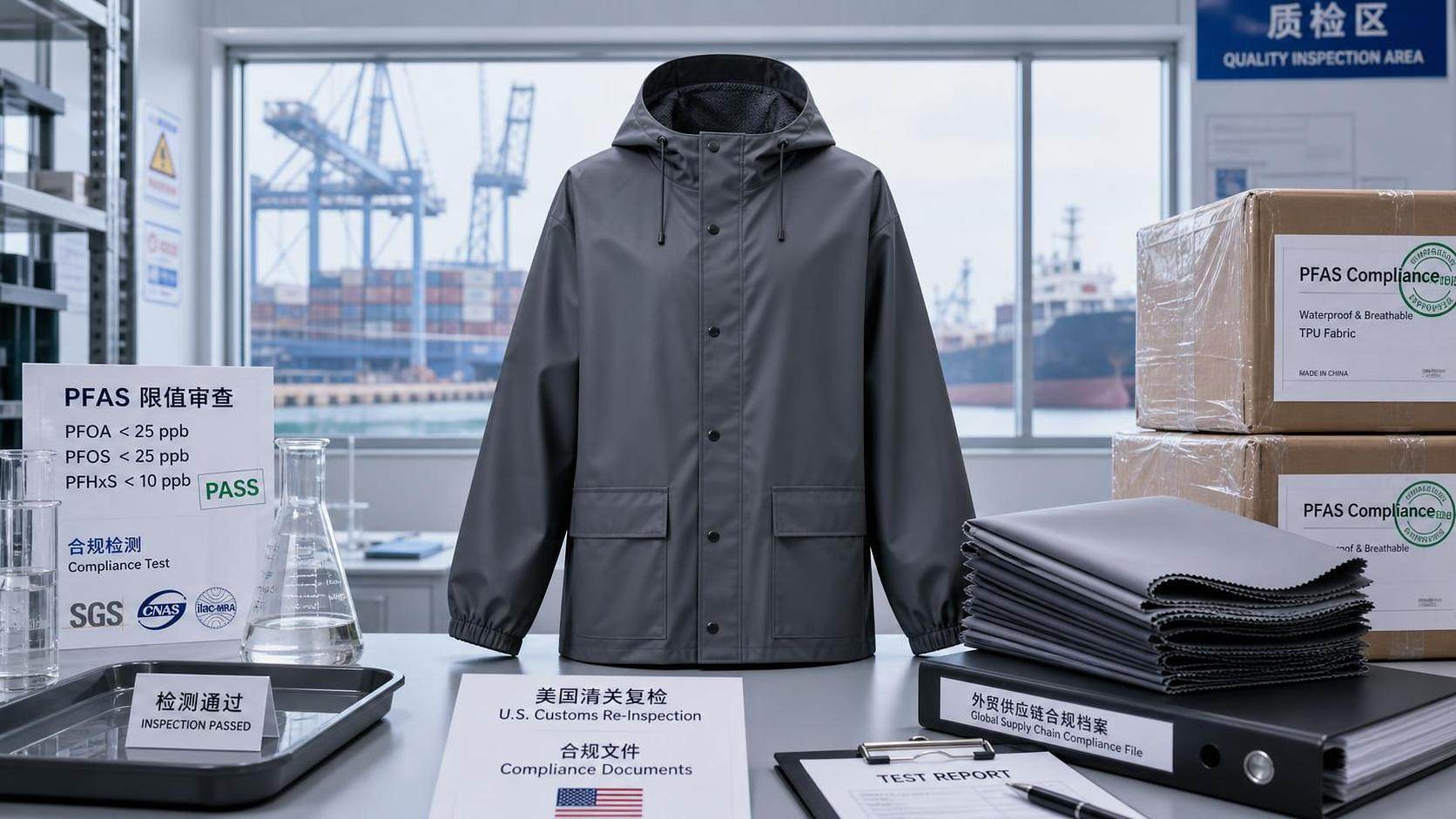
On July 20, 2026, the U.S. Consumer Product Safety Commission (CPSC) issued an urgent notice after multiple batches of TPU breathable raincoats imported from Asia were held at port for PFAS residues above the new under-10ppb threshold. For exporters, importers, compliance teams, distributors, and sourcing managers linked to the U.S. market, this matters because the issue is no longer theoretical: the rule is already in force, and customs clearance as well as distribution access can now be directly disrupted by non-compliant product lots.
What the CPSC Notice Confirmed
According to the information provided, the CPSC announced on July 20, 2026 that multiple recent shipments of TPU breathable raincoats imported from Asia were detained at port and placed into compliance reinspection because PFAS content exceeded the newly enforced limit of less than 10ppb. The threshold is a core provision of the CPSC-TPU-2026 standard, which became mandatory on July 1, 2026. The notice indicates that this requirement directly affects U.S. customs clearance and distribution eligibility for TPU raincoats. The same notice also makes clear that overseas importers should immediately review supplier DWR coating test reports and the validity of third-party PFAS-Free certifications.
Where the Pressure Lands in the Supply Chain
Export shipments face an immediate clearance risk
From an industry perspective, direct trading companies shipping TPU raincoats to the United States are the first to feel the impact because the issue appears at the border. The main business exposure is shipment detention, reinspection, and possible disruption to planned delivery schedules. What deserves closer attention is whether product documentation and compliance evidence can support customs and distribution requirements without delay.
Manufacturing and finishing processes come under closer review
For processing and manufacturing businesses, the notice puts practical attention on the production stage tied to DWR coating use and related material controls. Analysis shows that even where finished goods are already produced, the focus quickly shifts to whether test reports accurately support the compliance status of the raincoat lot being shipped. The key change to watch is not only the product result, but also whether the supporting compliance file remains valid and current.
Importers and distributors carry downstream access risk
Importers and channel operators may be affected because distribution access is explicitly linked to the new standard. In business terms, the risk extends beyond port handling to inventory availability, launch timing, and customer commitments in the U.S. market. Observably, companies in this position need to watch for any gap between supplier assurances and the documentation required for actual market entry.
Supply chain service providers may face timing and coordination pressure
Supply chain and compliance service providers are also likely to be drawn in where detained batches require reinspection and document verification. The operational impact may show up in exception handling, shipment coordination, and communication between suppliers, importers, and U.S.-side partners. What deserves closer attention is whether supporting documents can be checked early enough to reduce disruption once cargo reaches port.
What Companies Should Check Now
Reconfirm DWR-related test documentation
The most immediate practical point is the supplier-side DWR coating test report referenced in the notice. Companies linked to affected TPU raincoat shipments should verify whether the relevant documentation is complete, current, and tied to the actual products entering the U.S. market.
Validate PFAS-Free certification status
The notice specifically highlights third-party PFAS-Free certification validity. In practice, this means businesses should not treat older or generic certification files as automatically sufficient. The immediate task is to confirm that the certification remains valid and can support the relevant shipment or product line.
Separate policy wording from shipment execution
Analysis shows that one of the main operational risks is assuming that regulatory awareness alone is enough. The July 1, 2026 enforcement date means the standard has already moved into execution. For companies, the practical issue is whether internal sourcing, documentation review, and shipment release processes have caught up with that enforcement reality.
Prepare for customer and partner communication
Where cargo has already shipped or is close to shipment, businesses should pay attention to communication across suppliers, importers, and downstream customers. The immediate concern is not broad corporate messaging, but how to address possible delays, compliance questions, and document requests tied to detained or rechecked lots.
Why This Notice Matters Beyond One Detention Case
Observably, this development is more important as an enforcement signal than as a standalone shipment incident. The confirmed facts show that the new PFAS threshold is already being applied in a way that affects port handling and market access for TPU raincoats. It is more appropriate to understand this as a live compliance checkpoint for the category rather than a distant regulatory backdrop. At the same time, based on the information provided, it should still be treated as a developing industry dynamic that merits continued monitoring rather than a basis for wider conclusions beyond the affected scope.
How the Industry Should Read It for Now
At this stage, the most balanced reading is that the CPSC notice marks an immediate compliance issue for TPU breathable raincoats entering the U.S. market and a broader warning for companies relying on existing supplier assurances without recent verification. Analysis shows that the short-term impact is concentrated in clearance, reinspection, and documentation readiness, while the longer-term significance depends on whether similar enforcement actions continue to appear across future shipments. For now, it is more appropriate to view this as both an active short-term trade compliance risk and a longer-term signal that documentation quality around PFAS claims is becoming a decisive operational factor.
Basis of This Article and What Still Needs Verification
This article is based on the user-provided news title, event date, and event summary. For this type of development, relevant source categories typically include official notices, company disclosures, industry association updates, authoritative media reporting, and standard-setting documents. No specific official source link was provided in the input, so the exact official publication path still needs to be continuously verified. The main follow-up points to watch are any further official wording from the CPSC, any clarification tied to the CPSC-TPU-2026 standard, and any additional enforcement developments affecting TPU raincoat clearance and distribution access in the U.S. market.