
Industry Portal
Related News
- 00
0000-00
Outdoor Shade System Pricing: What Drives Installed Cost for Commercial Projects? - 00
0000-00
How Export Buyers Can Specify Luggage Hardware for Reliable Travel Goods Supply - 00
0000-00
How to Choose a PC Business Suitcase That Protects Laptops and Handles Frequent Travel - 00
0000-00
How to Evaluate an Outdoor Awning Components Supplier for Coastal Installations - 00
0000-00
How to Select Breathable Outdoor Shade Fabrics for Hot, Windy Patios
Tags
ECHA PFAS Restriction Reshapes EU Rainwear Compliance
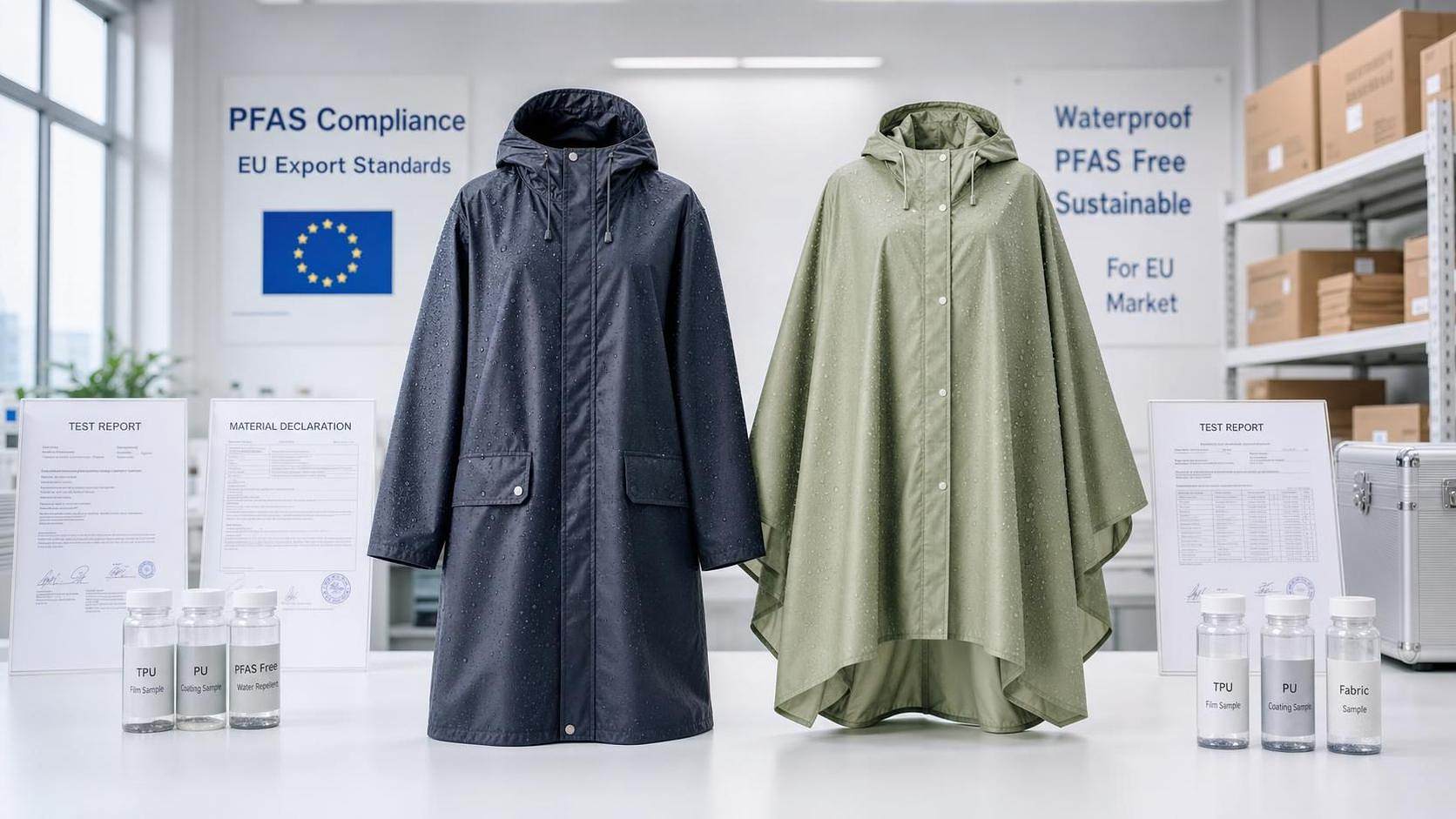
On July 19, 2026, the European Chemicals Agency (ECHA) announced a REACH restriction that will take effect on October 1, 2026 and will fully restrict the use of PFAS fluorinated surfactants in textile water-repellent finishing. For exporters of products such as TPU breathable raincoats and eco-PU fashion ponchos, the immediate issue is no longer only product performance, but whether DWR coating compliance can still be demonstrated through third-party PFAS-free test reports and supply chain declarations. This matters to manufacturers, exporters, sourcing teams, testing partners, and delivery planning because the rule change is directly tied to customs clearance and market access risk.
What the announced restriction confirms
According to the provided event summary, ECHA issued an official announcement on July 19, 2026. The announcement states that, from October 1, 2026, all PFAS fluorinated surfactants used in textile waterproof finishing will be comprehensively restricted. The scope described in the input includes DWR coatings used on TPU breathable raincoats and eco-PU fashion ponchos. The same summary states that exporters will be required to provide third-party PFAS-free test reports and supply chain declarations. If these materials are not available, the stated risks include customs rejection and market sales bans. The provided information also confirms that this restriction directly affects the compliance route and certification cost of Chinese rainwear manufacturers exporting to Europe.
Where the pressure shifts across the export chain
For rainwear manufacturers, coating compliance becomes a release condition
From an industry perspective, the manufacturing impact sits most directly in the DWR finishing stage. Producers of TPU and PU rainwear may be affected because the restriction is tied to the chemical status of the waterproof finishing used on export products. What deserves closer attention is that compliance may now depend not only on internal material selection, but also on whether the finished product can be supported by the required PFAS-free report and supply chain declaration before shipment.
For exporters and trading companies, documentation risk moves closer to market access risk
Export-facing businesses may be affected because the rule change is presented together with explicit consequences for customs clearance and market sale. In practical terms, the business pressure falls on order confirmation, shipment preparation, and document readiness. Companies handling EU-bound rainwear should pay attention to whether their product files, supplier statements, and third-party test materials are aligned before delivery, since missing evidence is described as a trigger for rejection risk.
For sourcing and supply chain teams, supplier qualification may require another layer of review
Analysis shows that procurement teams may need to revisit suppliers involved in water-repellent finishing and coated material sourcing. The issue is not only price or lead time, but whether upstream partners can support a PFAS-free claim with consistent declarations and testable material status. This may affect supplier onboarding, batch confirmation, and handover between raw material sourcing and finished goods export documentation.
For testing and compliance service partners, proof format matters as much as proof itself
Testing-related service providers may see increased demand because the announced rule specifically refers to third-party PFAS-free testing reports. Observably, the impact is likely to fall on report preparation timelines, sample management, and consistency between test evidence and supply chain declarations. For exporters, the point to watch is whether technical files and testing arrangements are prepared early enough to avoid shipment disruption.
What companies should review now
Recheck whether current DWR formulations can still support EU-bound shipments
Companies shipping TPU breathable raincoats, eco-PU fashion ponchos, or similar items should first review which products rely on water-repellent finishing that may fall within the announced restriction. Analysis shows that this is a product-by-product and coating-by-coating compliance question, not only a general policy issue.
Prepare the evidence trail before orders move into shipment
The provided summary makes the documentation requirement clear at a high level: third-party PFAS-free test reports and supply chain declarations are expected. What deserves closer attention is whether those materials can be matched to actual export lots, product specifications, and supplier records. Where execution details are still not provided in the input, companies should treat this as an area requiring continued verification rather than assuming a settled practice.
Watch how buyers and commercial documents begin to reflect the restriction
Observably, one of the next practical changes may appear in procurement documents, customer compliance requests, and product specification exchanges. Even without further confirmed details in the input, exporters should monitor whether customers begin asking for PFAS-free confirmation earlier in the order cycle, especially for coated rainwear categories tied to DWR finishing.
Build more time into compliance and delivery planning
From an industry perspective, the announced restriction may affect delivery preparation because compliance evidence now sits closer to shipment release and market entry. It is more appropriate to understand this as a timing and documentation issue as much as a chemical compliance issue. Where testing, supplier declarations, and internal review are not synchronized, order execution could face delays.
Why this reads as an execution signal
Analysis shows that this development is more than a general policy discussion because the input provides a defined announcement date, a stated effective date, a specified application area in textile waterproof finishing, and explicit documentary expectations for exporters. At the same time, it should not yet be overstated as a fully settled operational framework in every detail, because the input does not provide the full execution wording, technical interpretation, or documentary format. It is more appropriate to understand this as a clear compliance signal with practical consequences already visible, while some implementation details still require close observation.
How the market should read this development
For the rainwear export sector, this announcement should be read as a rule change that shifts compliance from a background technical issue to a front-end trade condition. The most relevant takeaway is not simply that PFAS restrictions are tightening, but that DWR-coated TPU and PU rainwear destined for the EU may need renewed verification before shipment. A neutral reading is that the change already carries direct commercial relevance, while the precise pace of enforcement practice and documentation interpretation still deserves continued monitoring.
Basis of this article and what still needs verification
This article is based on the user-provided news title, event date, and event summary. For events of this type, commonly relevant source categories may include official announcements, releases from regulatory authorities, customs or trade authority notices, industry association updates, standard-setting documents, and reporting by authoritative media. No specific official source link was provided in the input, so the exact official link still needs to be verified on an ongoing basis. Follow-up attention should remain on implementation details, certification and testing interpretation, changes in buyer document requirements, market feedback, and how exporting companies are carrying the rule into actual shipment and compliance practice.